Guide
How does an espresso machine work: boilers, thermoblocks and pumps
Published
Note: This page contains affiliate links. If you buy through them we may earn a commission at no extra cost to you. Learn more
In short
An espresso machine heats water to around 90 to 96 °C and uses a pump to force it through a compact puck of finely ground coffee at about 9 bar. The heating system decides how well it handles milk: a single boiler or thermoblock suits mostly espresso, while a heat exchanger or dual boiler lets you brew and steam at the same time.
Products for this job
Compare all 7 productsNinja Luxe Premier: assisted tamper, scale and auto froth
Check price on AmazonAffiliate linkSage Bambino Plus: 3-second heat-up, auto milk wand
Check price on AmazonAffiliate linkSage Barista Express Impress: guided dosing and tamping
Check price on AmazonAffiliate link
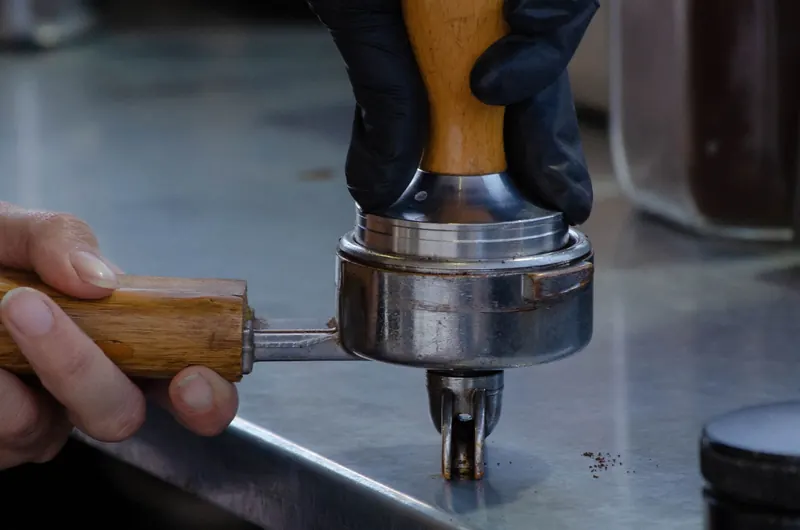
Every espresso machine does the same basic job: it pushes hot water through finely ground coffee under pressure, which extracts a small, concentrated shot with crema on top. Where machines differ is in how they heat water, how they build pressure and how they handle steam for milk. Those choices explain most of the differences in price, size and warm-up time. This guide explains the parts in plain terms and what each design means for your daily coffee.
The basic process
Water from the tank goes to a pump, then through a heater, and on to the group head, where the portafilter locks in. The group head spreads the water over the coffee through a shower screen. Pressure builds as the water meets the tightly packed puck, and espresso runs out of the portafilter spouts into the cup.
Two numbers matter most: temperature and pressure. Brew water is usually somewhere around 90 to 96 °C, and the standard pressure at the coffee is about 9 bar, roughly nine times the air pressure around us.
Pumps and pressure in bar
Most home machines use a vibration pump, a compact electromagnetic pump that is affordable and reliable. Higher end machines may use a rotary pump, which is quieter and can be plumbed into the mains. Some machines use a lever instead of a pump.
You will often see 15 bar or 19 bar on the box. That is the most the pump can produce, not the brewing pressure. In practice many machines limit pressure at the coffee to around 9 bar with a valve, and pressure also depends on the grind and dose. A higher pump rating does not mean better espresso.
Four heating systems compared
Milk needs steam, which needs water well above boiling point, while espresso needs water below it. How a machine handles those two temperatures is the main design choice.
Single boiler
Warm-up: about 10 to 20 min
Heat exchanger
Warm-up: about 15 to 25 min
Dual boiler
Warm-up: about 15 to 30 min
Thermoblock or thermojet
Warm-up: under 1 min
- Brew water path
- Steam path
Warm-up times are typical values; the maker's figure for your machine may differ.
| System | How it works | Good for | Trade off |
|---|---|---|---|
| Single boiler | One boiler switched between brew and steam temperature | Espresso, occasional milk | Wait between shot and steam |
| Thermoblock or thermocoil | Water heated on demand as it flows through | Fast warm up, compact machines | Less temperature stability on some |
| Heat exchanger | Steam boiler with a pipe of brew water running through it | Brewing and steaming together | Brew temperature needs managing |
| Dual boiler | Separate boilers for brew and steam | Several milk drinks in a row | Larger, longer warm up, costlier |
What each means in the cup
For espresso and americanos, a single boiler or thermoblock machine is perfectly capable. The Gaggia Classic, for example, is a single boiler machine, while many Sage machines use thermocoil or thermojet heating, which warms up quickly. With these you brew first, then switch to steam and wait for it to heat.
If you make two or three milk drinks back to back, a heat exchanger or dual boiler saves time because steam is always ready. The Sage Dual Boiler is an example of the latter. These machines are bigger and usually need longer to warm up from cold.
For more on choosing, see our best espresso machines for beginners and Sage espresso machines compared. If you want the milk done for you, the best espresso machines with automatic milk are worth a look.
Other parts that matter
The portafilter holds the basket of coffee. Common sizes are 51, 54 and 58 mm, which decides which tampers and baskets fit. See portafilter sizes by machine. A solenoid valve on many machines releases pressure into the drip tray after a shot, which leaves a drier puck. A pressure gauge, where fitted, shows how much resistance the puck gives. Some machines have PID temperature control, an electronic controller that holds brew temperature more steadily.
The grinder matters as much as the machine. Espresso needs a fine, even grind, so a capable burr grinder or a machine with one built in makes a big difference. Our best coffee grinders for espresso guide covers this, and espresso dose and ratio explains how much coffee to use.
Note:Boilers hold hot water and steam under pressure. Never open a boiler, valve or the machine case while it is on or hot.
Frequently asked questions
How many bar do I need for espresso? About 9 bar at the coffee is the usual standard. A 15 or 19 bar pump is common and fine, since the machine and the puck limit the real pressure.
Is a dual boiler espresso machine worth it? It is worth it if you often make several milk drinks in a row and want to brew and steam at once. For mostly espresso, a simpler machine does the job.
What is a thermoblock? A heater that warms water as it flows through, rather than storing it in a boiler. It heats quickly and saves space.
How does a bean-to-cup machine differ? It uses the same principles but automates grinding, tamping and brewing. See what is a bean-to-cup coffee machine.
What you need
- Check price on AmazonAffiliate link
Ninja Luxe Premier: assisted tamper, scale and auto froth
- Check price on AmazonAffiliate link
Sage Oracle Jet: auto grind, dose, tamp and milk
From: Sage espresso machines compared: Bambino Plus to Oracle
- Check price on AmazonAffiliate link
Gaggia Espresso Evolution: PID-controlled boiler
From: Gaggia coffee machines compared: Espresso Evolution, Deluxe, Brera and Anima